

 Login
Best HRIS in Canada for 2026: A Guide to Help You Decide
Updated

An SME needs to be able to count on the best HRIS to meet its needs and avoid having its many human resources documents scattered all over the place.
The natural reflex is to shop around for a human resources information system. The problem is that the market mixes highly polished American platforms, homegrown Canadian solutions focused on compliance, and international suites designed for organizations with more than 2,000 employees.
Choosing an HRIS in Canada therefore comes down to one specific question. Does the platform truly handle provincial HR standards and French, or does it simply do a good job of organizing your data?
This comparison reviews six solutions available in Canada, with their strengths and limitations, to help you quickly rule out the ones that aren’t a good fit.
Comparison table to find the best HRIS in Canada
Here is an overview before getting into the details, so you can quickly pinpoint the best HRIS in Canada for your profile.
| Solution | Origin | Target companies | Native Canadian payroll | Listed price |
|---|---|---|---|---|
| Folks | Quebec, Canada | Canadian SMEs with 10 to 500 employees | Yes, with Folks Payroll | From $6 per employee per month |
| BambooHR | Utah, United States | Small teams up to 1,000+ employees | No | US$10 (Core), US$17 (Pro), US$25 (Elite) |
| Altee | Boucherville, Quebec | SMEs | Data preparation only | Public pricing, no implementation fees |
| HiBob | United Kingdom, United States, Israel | Growing companies, often multi-country | Through integration | Quote-based |
| Collage HR | Toronto, Canada | Canadian SMEs up to 1,000 employees | Yes | Quote-based |
| Rise People | Burnaby, Canada | Canadian SMEs | Yes | Per employee per month, depending on modules |
Ranking of the best HRIS in Canada
This ranking favours depth of Canadian coverage, because the best HRIS in Canada is first and foremost the one that handles our country’s legal and linguistic specifics.
1. Folks, the best HRIS for Canadian SMEs
Folks is a Quebec-based platform designed for Canadian SMEs with 10 to 500 employees. It’s the solution most closely aligned with the reality of a Canadian employer, which is what earns it the top spot.
The system covers employee records, onboarding and offboarding, the org chart, absence management, training and certification tracking, an ATS to manage applications, document management with e-signature, and a mobile app. On top of that come recruiting, performance management and Folks Payroll, which handles remittances to the CRA and Revenu Québec, T4s, RL-1 slips and Records of Employment.
Its strengths lie in the platform’s true bilingualism, built-in federal and provincial compliance, and published pricing starting at $6 per employee per month.
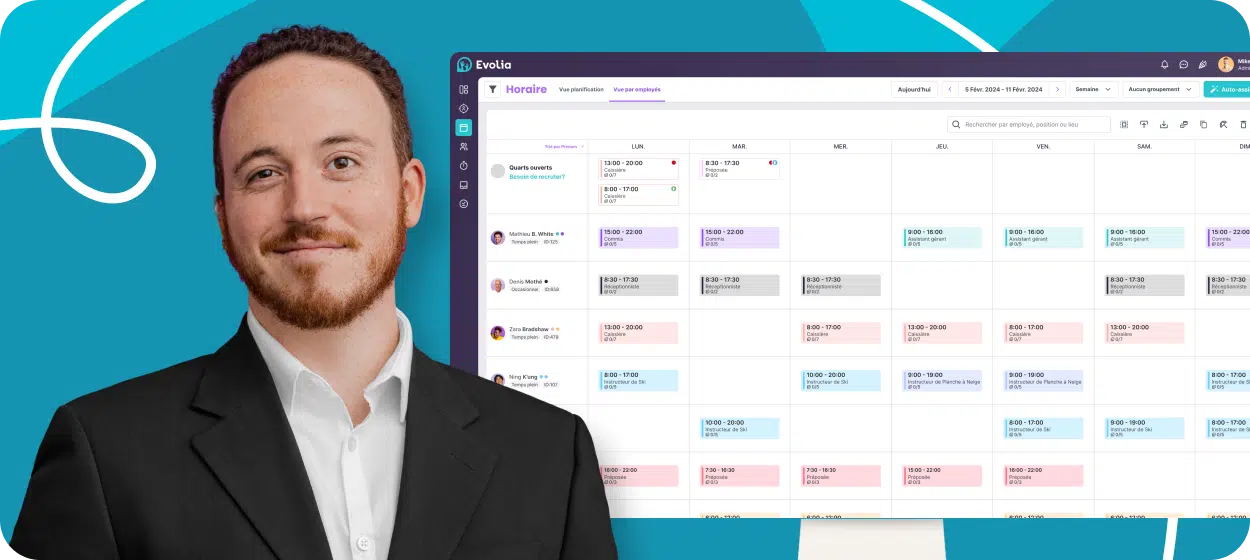
Complex shift scheduling can easily be handled through an external connection, such as the Folks and Evolia integration.
Ideal for Canadian SMEs that want to bring HR and payroll together in a single tool without the complexity of an enterprise suite, or that want a solution integrated with Canada’s other leading payroll providers.
2. BambooHR, the American benchmark for SMEs
Based in Utah, BambooHR serves organizations ranging from small teams to more than 1,000 employees. Its reputation rests on an interface that users can learn in just a few hours.
The offering covers employee records, approval workflows, applicant tracking, onboarding, time off and benefits, then extends to performance and compensation in the higher-tier plans.
Its main advantage remains pricing transparency, with plans listed at US$10, US$17 and US$25 per employee per month. Companies with 25 employees or fewer pay a flat monthly rate instead.
For a Canadian buyer, the limitation is a significant one. Its native payroll doesn’t cover Canada, and the localized payroll integrations it lists are for the United Kingdom, Australia and New Zealand.
Connecting BambooHR to Evolia also bridges the gap to many Canadian payroll solutions while giving you access to one of the most popular time management solutions in the country.
A good fit for Canadian companies that already have a payroll provider they’re happy with and are mainly looking for a solid HR foundation.
3. Altee, the Quebec HRIS with no implementation fees
Developed in Boucherville, Altee combines an HRIS with an applicant tracking system. Its approach is deliberately simple, with sign-up in under a minute and no implementation fees.
Its modules cover administrative management (records, training, expense reimbursements and equipment inventory), as well as employee experience, time management with timesheets and punch-in/punch-out, skills development and recruiting.
Data is hosted in Canada, with AES-256 encryption and Law 25 compliance. Pricing is available without having to talk to a salesperson, which is still rare in this category.
Its limitation is clear: the platform compiles and prepares payroll data, but doesn’t process payroll itself.
A smart choice for Quebec SMEs that want to get started quickly, without an implementation project or a negotiation cycle.
4. HiBob, the platform for organizations growing internationally
HiBob, which its users simply call Bob, targets mid-sized companies operating across several countries. The platform is known for its polished interface and its survey and analytics tools.
It includes core HR, onboarding, time-off management, performance, compensation planning and a payroll hub that relies on partners depending on the market.
On the other hand, pricing is available by quote only, which makes upfront comparisons more difficult, and Canadian payroll processing runs through an integration rather than a built-in engine.
It is, however, a good solution for Canadian organizations that hire abroad and want a single source of truth for HR data. It also connects to Evolia to handle scheduling, punches and other operational tasks.

5. Collage HR, the benefits-focused option
Founded in Toronto, Collage HR is now owned by People Corporation. Its signature feature is benefits administration, synced with Canadian insurers.
The platform brings together employee records, digital onboarding with TD1 and TD1X forms, time off, timesheets, performance, recruiting and Canadian payroll that produces T4s, T4As and Records of Employment. HR advisory services are included in its plans.
Its limitations are the lack of international payroll and pricing that’s only available on request.
A good fit for Canadian employers for whom benefits are a key part of their employee value proposition.
6. Rise People, payroll and HR combined for the Canadian market
Based in Burnaby, British Columbia, Rise People brings HR, payroll, benefits and time management together in a platform built for Canada.
Its payroll engine calculates and remits federal and provincial deductions, produces T4s and manages Records of Employment. Pricing is per employee per month, depending on the modules selected.
Its strengths are support from a Canadian team and accounting integrations with QuickBooks and Xero. Its limitations are the lack of multi-country payroll and exact pricing that requires a conversation with sales.
An option well suited to Canadian SMEs that want to consolidate payroll and HR with a homegrown provider.
Is your need more about shift scheduling and time tracking? Discover Evolia’s employee scheduling platform.
How to choose an HRIS in Canada
An HRIS is a five- to seven-year purchase. The following criteria separate the platforms that age well from the ones you end up replacing in a hurry.
- Payroll processing: Does the engine cover employer obligations to the CRA, Revenu Québec and provincial plans, or will you need to keep a separate provider?
- Interface and support language: In Quebec, your employees have the right to work in French, and that includes internal tools.
- Provincial compliance: The standards that apply are those of the province where the employee works, not where the head office is located.
- Time management: Are timesheets, punch-in/punch-out, premiums and overtime native features or available only through an integration?
- Data hosting and protection: Server location, encryption, and compliance with Quebec’s Law 25 and PIPEDA.
- True cost: Implementation fees, mandatory modules, monthly minimums and renewal clauses.
- Integration capabilities: An open API keeps you from getting locked into the vendor’s partners only.
One point is often overlooked. Teams with variable schedules have operational needs that HRIS platforms don’t cover in depth, such as shift assignment, call-in lists and evening premiums. Our article on employee scheduling for growing teams outlines what to consider before you sign, and a refresher on employment standards by province helps you avoid adjustments after the fact.

Choosing the best HRIS in Canada for your growth
The best HRIS in Canada isn’t the same for every organization. These six platforms address different realities, and the wrong choice almost always comes from a criterion that was overlooked during the comparison.
For a Canadian SME that wants to structure its HR and run payroll in one place, Folks is often the most consistent option. For an organization whose complexity lies in scheduling, the HRIS is only part of the equation.
List your real pain points, test each finalist on your most complex use case, then validate the total cost over three years.
Book a demo with a specialist to assess your situation.
FAQ
What is the best HRIS in Canada for an SME?
The best HRIS in Canada depends on your priorities. An SME that wants to centralize its HR and Canadian payroll in a single system will generally turn to Folks, Collage HR or Rise People. A company that already has a payroll provider it’s happy with may prefer an HR foundation like BambooHR. Start by comparing payroll coverage, support language and provincial compliance.
How much does an HRIS cost in Canada?
Listed prices generally range from $6 to $25 per employee per month, depending on the platform and modules selected. Several vendors only share their pricing by quote. Always factor in implementation fees, mandatory modules and monthly minimums, as these often drive up the real cost significantly. Then ask for a detailed written quote.
What is the difference between an HRIS and payroll software?
An HRIS centralizes employee data and processes, such as records, onboarding, absences, performance and recruiting. Payroll software calculates pay and remits source deductions to government authorities. Some platforms combine both functions, while others only prepare the data before sending it to a separate payroll system.
1537

Read next

Workforce
Minimum Wage in Canada by Province and Territory: Complete Guide
Find the minimum wage in Canada by province and territory: current rates, effective dates and confirmed upcoming increases for your payroll.
Read article
Workforce
Maternity and Parental Leave in Canada: A Guide by Province
Learn how maternity and parental leave in Canada works by province: job-protected leave lengths, eligibility, and how QPIP differs from Employment Insurance.
Read article
Schedule ManagementWorkforce
Overtime in Canada: Thresholds by Province and Territory
Explore overtime rules in Canada by province and territory: trigger thresholds, applicable rates and the time bank rules to follow.
Read article